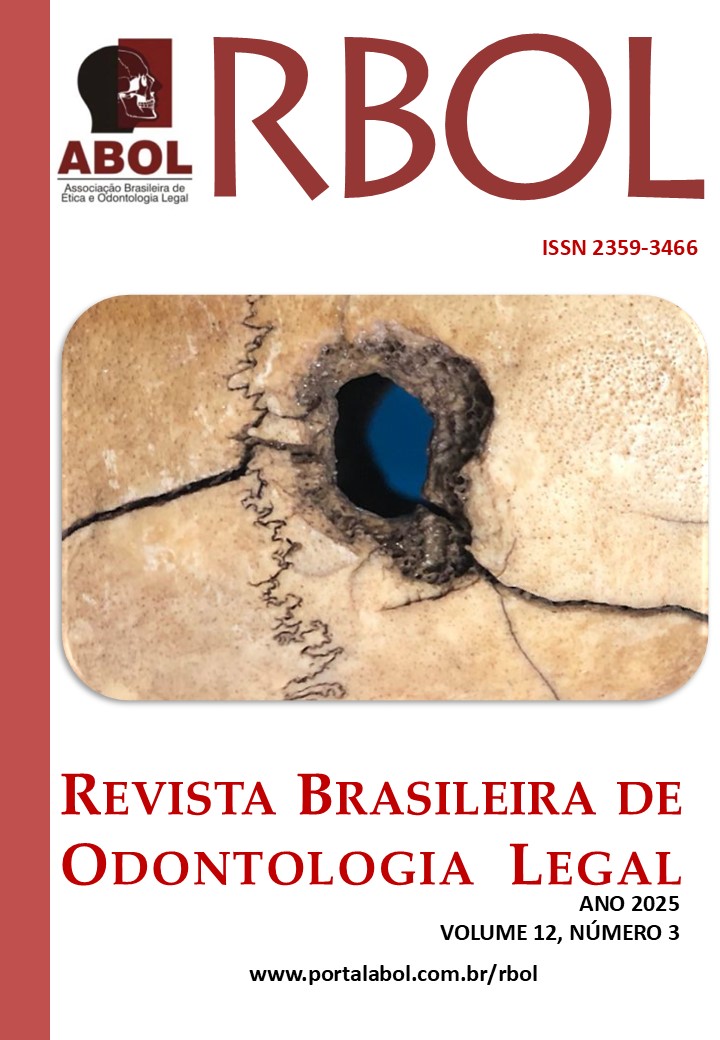
ATYPICAL CRANIOFACIAL INJURY CAUSED BY A FIREARM PROJECTILE IN THE MAXILLARY BONE: CASE REPORT
DOI:
https://doi.org/10.21117/rbol-v12n32025-665Palabras clave:
Forensic Ballistics, Cranioencephalic Injuries, Forensic TraumatologyResumen
Firearm injuries present a significant challenge for forensic sciences, requiring precise analysis of ballistic mechanisms and their effects on skeletal structures. Forensic odontology has increasingly contributed to examining craniofacial injuries, supporting both scientific interpretation and legal processes. This study reports the forensic analysis of a skeletonized skull with two distinct firearm projectile (FP) trajectories. While classic ballistic signs such as external beveling, radiating fractures, and the Bonnet funnel sign were observed, particular focus is given to an unusual orifice in the left maxilla. This lesion, marked by irregular borders and extensive comminution, deviated from typical entry and exit wound patterns, demonstrating how bone thickness and fragility influence ballistic damage. The sequential assessment of injuries suggested that the first shot occurred at the left temporoparietal junction, followed by a facial shot. The maxillary orifice, in particular, raised hypotheses about the symbolic or practical intent behind the second shot, aligning with literature describing disfigurement practices in homicidal cases. The case highlights the complexity of interpreting firearm injuries in delicate facial bones and emphasizes the importance of detailed osteological examination when faced with unusual presentations. It underscores the value of combining forensic anthropology, dentistry, and ballistics to reconstruct projectile trajectories and develop hypotheses about the dynamics of violent death. Given the increasing circulation of firearms and persistently high homicide rates in Brazil, the study emphasizes the scientific and judicial importance of interdisciplinary forensic approaches supported by thorough documentation.
Descargas
Publicado
Número
Sección
Licencia
Os autores deverão encaminhar por email, devidamente assinada pelos autores ou pelo autor responsável pelo trabalho, a declaração de responsabilidade e transferência de direitos autorais para a RBOL, conforme modelo abaixo.
DECLARAÇÃO DE RESPONSABILIDADE E TRANSFERÊNCIA DE DIREITOS AUTORAIS
Eu (Nós), listar os nomes completos dos autores, transfiro(rimos) todos os direitos autorais do artigo intitulado: colocar o título à Revista Brasileira de Odontologia Legal - RBOL.
Declaro(amos) que o trabalho mencionado é original, não é resultante de plágio, que não foi publicado e não está sendo considerado para publicação em outra revista, quer seja no formato impresso ou no eletrônico.
Declaro(amos) que o presente trabalho não apresenta conflitos de interesse pessoais, empresariais ou governamentais que poderiam comprometer a obtenção e divulgação dos resultados bem como a discussão e conclusão do estudo.
Declaro(amos) que o presente trabalho foi totalmente custeado por seus autores. Em caso de financiamento, identificar qual a empresa, governo ou agência financiadora.
Local, data, mês e ano.
Nome e assinatura do autor responsável (ou de todos os autores).